
With the rise in automation and the rapid development of industrial technology, modern manufacturing and logistics are inseparable from the support of information automation. Automated Guided Vehicles (AGVs) have become the backbone of factory logistics, enabling unmanned transport both on the ground and in the air. They achieve flexible, efficient, and convenient automated distribution. Their advantages are increasingly prominent, making them ubiquitous in factories, enterprises, e-commerce, and logistics companies alike.
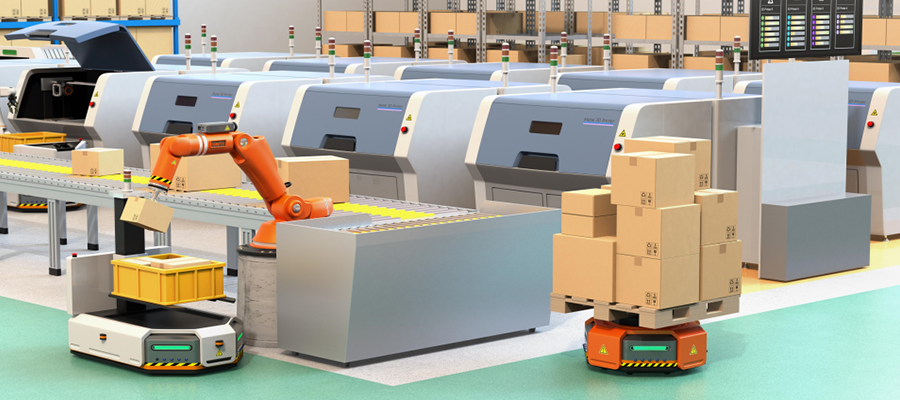
AGVs Effortlessly Achieve Unmanned Handling.
An Automated Guided Vehicle (AGV) is a vehicle equipped with an automatic guidance device that can travel along predetermined paths. Simply put, it is a driverless cart capable of autonomous movement within production lines and warehouses to complete cargo handling and transportation tasks. As an advanced handling device, AGVs utilize intelligent scheduling and planning systems to perform unmanned operations. They play a vital role in improving work efficiency, reducing costs, enhancing product quality, and lowering labor intensity, effectively cutting corporate expenses while boosting economic returns.
How Exactly Do AGVs Transport Goods?
Given their popularity, how do AGVs actually achieve unmanned handling? Today, let’s take a closer look at the sensors that power AGV transportation and decode the principles behind their high-efficiency movement!
Generally, AGVs use electromagnetic or optical automatic guidance devices to navigate along specified paths. As a crucial tool for flexible and automated logistics, AGVs do not require complicated track laying or fixed brackets like other conveying tools. They face fewer restrictions regarding workspace and have achieved millimeter-level positioning accuracy.
Sensors act as the "facial features" of an AGV. Different sensors offer varying levels of detection accuracy and response times. So, which sensors are essential? Commonly used for obstacle avoidance are laser sensors, infrared sensors, visual sensors, and ultrasonic sensors.
• A Sensor Widely Used in AGVs — Laser Measurement Sensors
Lanbao Recommendation: PDA Series
Laser measurement sensors are used for precise positioning and obstacle avoidance. Installed at the front or sides of the vehicle, they employ point laser triangular reflection and the Time-of-Flight (TOF) principle to accurately measure the distance between the target and the AGV. This enables precise positioning and collision avoidance with accuracy up to the millimeter level and a ranging distance of up to 8 meters, facilitating smarter movement.
• A Sensor Widely Used in AGVs — Photoelectric Sensors
Lanbao Recommendation: PSE Series
Accurate positioning during transport is a critical aspect of AGV operation. To ensure precision and reliability, suitable sensors must be employed.
A photoelectric sensor consists of a light source (emitter) and a receiver. The receiver detects the presence or absence of light. These sensors typically use triangulation or the TOF principle for obstacle avoidance. Triangulation determines the position of an object based on the location/angle of reflected light on the sensor's photosensitive element, while TOF calculates the position based on the time it takes for photons to bounce back from the object. With advantages such as low cost, small measurement spots, and wide applicability, photoelectric sensors are currently the most widely used sensors in AGVs.
Lanbao Recommendation: PSE Series
Accurate positioning during transport is a critical aspect of AGV operation. To ensure precision and reliability, suitable sensors must be employed.
A photoelectric sensor consists of a light source (emitter) and a receiver. The receiver detects the presence or absence of light. These sensors typically use triangulation or the TOF principle for obstacle avoidance. Triangulation determines the position of an object based on the location/angle of reflected light on the sensor's photosensitive element, while TOF calculates the position based on the time it takes for photons to bounce back from the object. With advantages such as low cost, small measurement spots, and wide applicability, photoelectric sensors are currently the most widely used sensors in AGVs.
• A Sensor Widely Used in AGVs — Ultrasonic Sensors
Lanbao Recommendation: UR30-CM2/CM3/CM4 Series
Also known as AGV intelligent transport robots, these vehicles are a branch of wheeled mobile robots. Their key technologies lie in positioning, navigation, and anti-collision.
Ultrasonic anti-collision utilizes the property of ultrasound reflecting off obstacles. Ultrasonic sensors detect the distance to obstacles to prevent collisions. Unlike laser sensors, which only cover a horizontal plane, ultrasonic waves emit in a spatial range, compensating for the blind spots of laser sensors and ensuring more comprehensive safety.
Due to their low cost, fast information acquisition speed, and high distance resolution, ultrasonic sensors have long been widely used in AGV navigation and positioning. Furthermore, they do not require complex image processing technology to collect environmental information, allowing AGVs to achieve fast, real-time ranging without being affected by weather, ambient light, or obstacle shadows.
Also known as AGV intelligent transport robots, these vehicles are a branch of wheeled mobile robots. Their key technologies lie in positioning, navigation, and anti-collision.
Ultrasonic anti-collision utilizes the property of ultrasound reflecting off obstacles. Ultrasonic sensors detect the distance to obstacles to prevent collisions. Unlike laser sensors, which only cover a horizontal plane, ultrasonic waves emit in a spatial range, compensating for the blind spots of laser sensors and ensuring more comprehensive safety.
Due to their low cost, fast information acquisition speed, and high distance resolution, ultrasonic sensors have long been widely used in AGV navigation and positioning. Furthermore, they do not require complex image processing technology to collect environmental information, allowing AGVs to achieve fast, real-time ranging without being affected by weather, ambient light, or obstacle shadows.
In today's era of rapidly advancing artificial intelligence, the integration of AI and manufacturing has become a crucial means of industrial upgrading. This also brings immense development opportunities to the sensor industry.
Looking ahead, as industrial automation continues to evolve, Shanghai Lanbao will empower more enterprises to complete their intelligent transformation!
Post time: Jun-10-2026