
On semiconductor wafer transfer lines, the gap between robotic grippers is less than 1 cm. In 3C electronic assembly stations, components are packed edge-to-edge. In lithium battery cell stacking stations, every millimeter of space is carefully budgeted...
Engineers frequently run into a thorny dilemma:
• High detection precision → requires a powerful amplifier to process weak capacitive signals.
• Compact form factor → traditional cylindrical sensors simply won't fit into tight stations.
• Convenient commissioning → indicator lights and potentiometers get obstructed, leaving teams to "tune blind".
Precision, size, and commissioning convenience – this "impossible triangle" has long been the biggest barrier to applying capacitive sensors in compact workstations.
LANBAO's answer is a split architecture: physically separating the sensing head from the amplifier. The sensing head retains only a minimal electrode structure, compressing its thickness to the extreme; the amplifier is placed independently, equipped with clear status indicators and a multi-turn potentiometer for effortless adjustment and monitoring. The CE05S is the flagship embodiment of this philosophy.
1. Three Core Advantages of the LANBAO CE05S
Advantage 1: 5.5 mm Ultra-Thin Flat Sensing Head
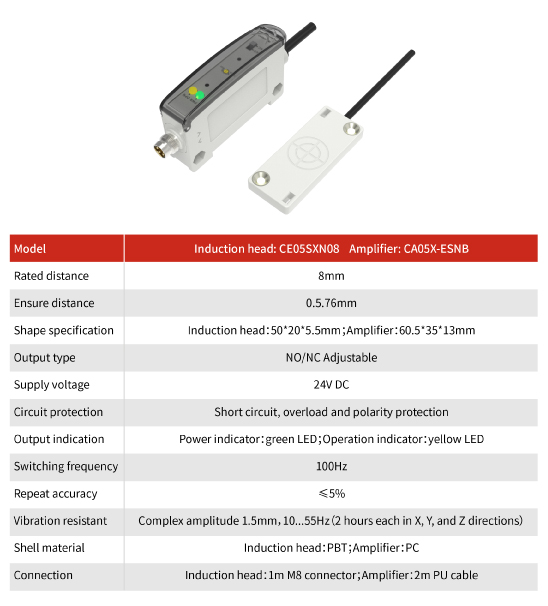
With a thickness of just 5.5 mm, the flat design allows the CE05S to easily enter narrow stations where traditional cylindrical sensors (typically 8 mm diameter and above) dare not venture. Whether it's the dense arrangement of precision electronic components or the compact layout of automated equipment, the LANBAO CE05S truly "fits in where others can't."
Advantage 2: 100 Hz High-Speed Response
A switching frequency of 100 Hz means 100 stable detections per second. Even on high-speed production lines, facing fast-moving targets, the CE05S delivers zero missed detections.
Advantage 3: Separate Amplifier – "Crystal Clear" Commissioning
The CA05X amplifier sits independently outside the sensing head, flexibly positioned wherever observation is convenient:
· Clear operating status indication – PWR green LED and OPN yellow LED provide real-time feedback, eliminating "blind guessing" during debugging.
· Sensitivity adjustment via multi-turn potentiometer – precise Min/Max fine-tuning adapts to different materials and distances.
· NO/NC switching – one-click output logic toggle on site, reducing spare-part SKU requirements.
This design decouples the "extreme miniaturization of the sensing head" from the "full functionality of the amplifier" – the head focuses purely on sensing, the amplifier focuses purely on judgment. Neither compromises the other; both perform at their best.
2. LANBAO CE05S Split Capacitive Sensor – Product Introduction
3. Typical Application Scenarios of the LANBAO CE05S
Built on the combined strengths of "ultra-thin + split + high-speed," the CE05S shines particularly bright in the following scenarios.
Semiconductor Wafer / Silicon Slice Pass-Through Detection: Wafers are transferred at high speed through narrow slits. The 5.5 mm flat sensing head mounts flush against the chamber wall, while the 100 Hz response precisely captures the pass-through moment of every single wafer.
3C Electronics Precision Assembly: In smartphone mid-frame and PCB component inspection stations where space is measured in millimeters, the CE05S "fits in where others can't" – making it the ideal choice for compact workstations.
Lithium Battery Cell Stacking Stations: With rapid stacking rhythms and high precision demands, the 100 Hz response ensures every cell is accurately counted and positioned.
Automotive Parts High-Speed Assembly: Mixed metal and non-metal detection, installation in confined spaces – the CE05S's "split architecture" makes detection in complex stations no longer a challenge.
Intelligent Logistics Sorting: Presence detection for parcels of varying materials; the multi-turn potentiometer makes sensitivity adjustment "hit exactly where you aim."
The split architecture decouples the sensing probe from amplifier functionality – achieving extreme slimming to fit various millimeter-level tight workstations, while retaining complete commissioning performance and stable detection capability. This precisely matches the needs of high-end automation scenarios such as semiconductor, 3C electronics, lithium battery, and automotive intelligent manufacturing.
It effectively overcomes industry pain points such as restricted installation in narrow spaces, missed detections on high-speed lines, and inconvenient on-site commissioning. With its product characteristics of high adaptability, high stability, and high flexibility, it fills the gaps in precision production line detection.
Post time: Aug-17-2026