
The rapid expansion of global e-commerce has transformed the logistics industry into a high-stakes arena of speed and precision. Modern distribution centers now process millions of parcels daily, requiring automation systems that operate without interruption. Within these sprawling facilities, the accuracy of high-speed sorting determines the overall throughput and customer satisfaction. Every package, regardless of its shape or material, must be identified and directed with absolute certainty.
To meet these rigorous demands, identifying a reliable China Photoelectric Sensor Manufacturer has become a priority for system integrators worldwide. LANBAO provides the advanced optical solutions necessary to navigate the complexities of 24/7 automated environments. By focusing on innovative detection principles, these technologies ensure that smart logistics networks maintain their momentum and operational integrity.

The Intelligence Audit: Navigating the Complexities of High-Speed Logistics Sorting
High-speed sorting systems represent the pinnacle of mechanical and electronic synchronization. Conveyor belts often move at several meters per second, leaving only milliseconds for a sensor to trigger a mechanical diverter. Historically, traditional sensors struggled with the sheer variety of modern packaging materials. Today, a parcel might be a matte black cardboard box, a highly reflective silver poly-mailer, or a transparent plastic wrap. Each surface interacts with light differently, creating a significant challenge for intensity-based detection systems.
An intelligence audit of a modern warehouse reveals that detection errors are the primary cause of system bottlenecks. When a sensor fails to “see” a dark object, the parcel bypasses its intended destination, leading to manual intervention and increased costs. Furthermore, environmental factors such as bright overhead LED lighting or dust accumulation can interfere with optical signals. Consequently, the industry requires a new generation of hardware that prioritizes stability over simple light reflection. This transition to intelligent sensing allows logistics firms to automate even the most difficult sorting tasks with confidence.
Q1: How Does TOF Technology Neutralize the Variability of Modern Packaging Materials?
The core challenge in logistics lies in the inconsistency of target surfaces. Standard photoelectric sensors rely on the intensity of reflected light, which varies wildly between a white box and a black one. In contrast, Time-of-Flight (TOF) technology measures the actual distance to the object by calculating the time it takes for a light pulse to travel to the target and back. Because TOF measures time rather than light intensity, the color or reflectivity of the package becomes largely irrelevant.
Specifically, the LANBAO PSE-CM4/PSE-CM4 series utilizes this TOF principle to provide exceptional detection stability. Even when a parcel is deep black or highly glossy, the sensor maintains a consistent trigger point. This capability eliminates the “black object” problem that has historically plagued high-speed sorting lines. By focusing on the physical distance of the object, the system ensures that every item on the conveyor is accounted for, regardless of its aesthetic properties. This shift allows for a more flexible sorting process that handles diverse inventory without constant recalibration.
Q2: Why Is a 5-Meter Sensing Range the Strategic Benchmark for Wide-Span Warehouse Layouts?
Modern warehouse architecture often utilizes wide-span conveyors and large sorting matrices to maximize spatial efficiency. In these layouts, sensors must frequently monitor wide gaps or detect objects from a significant distance to avoid interfering with mechanical movement. Short-range sensors require mounting arms that extend into the operational path, increasing the risk of mechanical damage. A 5-meter sensing range provides the necessary clearance to mount hardware safely out of reach while maintaining full coverage.
The PDE-CM5 TOF sensor offers a stable 5-meter range, which is sufficient to cover the typical width of even the largest industrial conveyor systems. This long-range capability allows for overhead mounting, where the sensor can look down upon the sorting area without being obstructed by side rails or low-hanging machinery. Moreover, a longer range reduces the total number of sensors required. Instead of multiple short-range units, a single high-performance TOF sensor can monitor a wide area, simplifying wiring architecture and lowering overall system complexity.
Q3: Can a Single Photoelectric Sensor Simultaneously Manage High-Speed Triggering and AGV Collision Avoidance?
In a smart warehouse, sensing requirements extend beyond the conveyor belt to the mobile equipment moving throughout the facility. Automated Guided Vehicles (AGVs) and forklifts require reliable collision avoidance systems to operate safely alongside human workers. While these vehicles traditionally used different sensors than sorting lines, advanced TOF sensors now offer the versatility to handle both high-speed triggering and safety-critical positioning.
In this regard, the PDE-CM8TGI serves as a dual-purpose tool. Its high-frequency response makes it ideal for the rapid-fire triggering required in sorting. Simultaneously, its long-range accuracy and robust detection logic make it perfect for AGV navigation and collision prevention. When mounted on a vehicle, the sensor monitors the distance to obstacles in real-time. If an object enters the safety zone, it immediately signals the vehicle’s control system to slow down or stop. This synergy allows logistics providers to standardize their inventory, using the same high-performance hardware across multiple applications.
Q4: How Does LANBAO’s R&D Infrastructure Ensure Signal Integrity Amidst Industrial Light and Electronic Noise?
Industrial environments are notoriously “noisy” both optically and electrically. Powerful overhead lights and sunlight from skylights can saturate standard optical receivers, leading to false triggers. Furthermore, high-power motors and high-voltage equipment generate significant electromagnetic interference (EMI). Signal integrity is the cornerstone of a reliable automation system and requires specialized engineering to maintain.
LANBAO invests heavily in R&D to build resilience into the PDE-CM5’s internal circuitry. The sensor utilizes advanced optical filtering that specifically targets the wavelength of its own light pulse while ignoring ambient illumination. This ensures the device remains “blind” to external light sources even in brightly lit areas. Additionally, the internal electronics feature enhanced electromagnetic shielding to prevent EMI from distorting the signal. By prioritizing signal integrity, the manufacturer minimizes the risk of “ghost” triggers that often cause unexpected system halts.
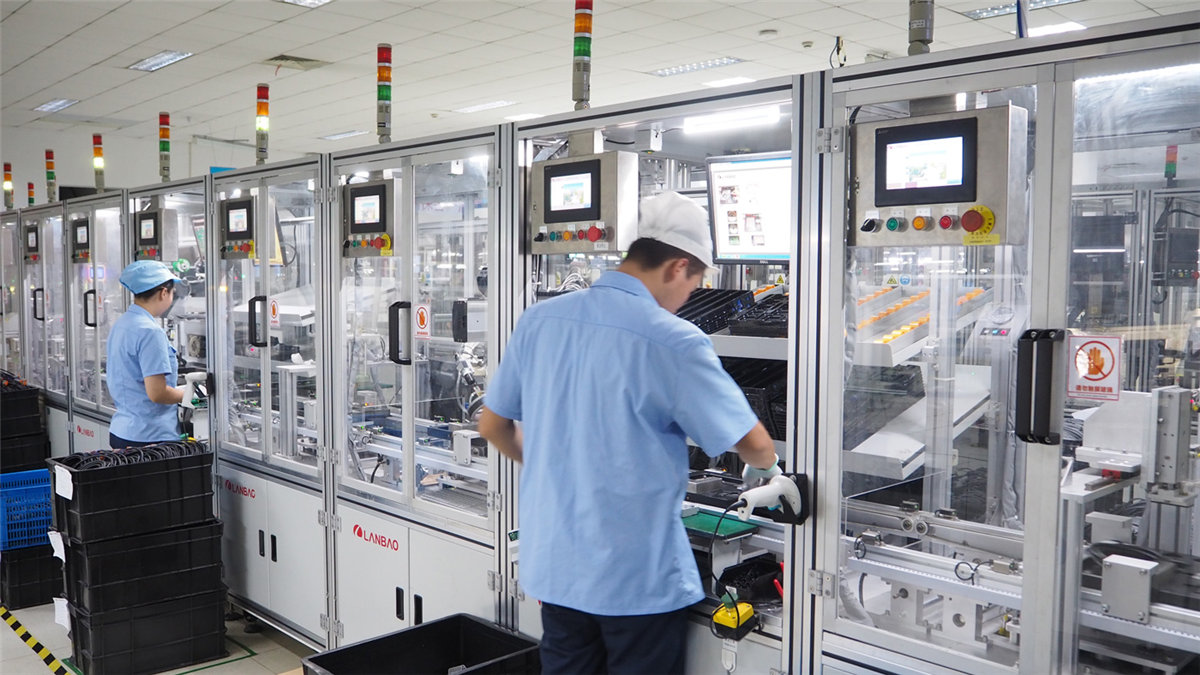
Q5: What Is the Strategic Value of Partnering with a China-Based Specialized Sensor Manufacturer for Global Logistics Firms?
For global logistics firms, choosing a hardware partner is a strategic decision affecting long-term operational costs. Partnering with a specialized manufacturer like LANBAO offers advantages in supply chain agility and technical customization. As a manufacturer with integrated R&D and production, LANBAO can respond quickly to the specific needs of a facility, whether through custom mounting brackets or specialized firmware for unique sorting logic.
The economic benefits are also substantial. High-end TOF sensors direct from the source provide a superior price-to-performance ratio compared to generic components. Access to direct technical support ensures that system integrators can optimize settings for specific conveyor speeds and package types. This partnership provides a continuous feedback loop that drives product improvement. As logistics technology evolves, having a partner that controls the entire R&D process ensures firms always have access to the latest sensing innovations.
Beyond Detection: Building a Seamless Sorting Ecosystem with LANBAO TOF Solutions
The ultimate goal of smart logistics is to create a seamless ecosystem where data flows as smoothly as physical goods. High-performance TOF sensors are the foundation of this vision. By providing reliable, color-independent data at high speeds, they allow control software to make perfect decisions in real-time. This reliability reduces the need for manual sorting stations and allows facilities to push throughput to the limit.
Standardizing on high-quality TOF solutions, such as the PDE-CM series, transforms sensing from a potential point of failure into a strategic asset. These sensors empower logistics providers to handle a more diverse range of products with greater efficiency and safety. In the competitive world of modern supply chains, the ability to sort faster and more accurately is the key differentiator. Choosing the right sensing partner ensures that a facility is not just reacting to today’s demands, but is ready for the automated challenges of tomorrow.
For more information on high-performance photoelectric sensing solutions and technical specifications, please visit the official website: https://www.cnlanbaosensor.com/.
Post time: Apr-14-2026